
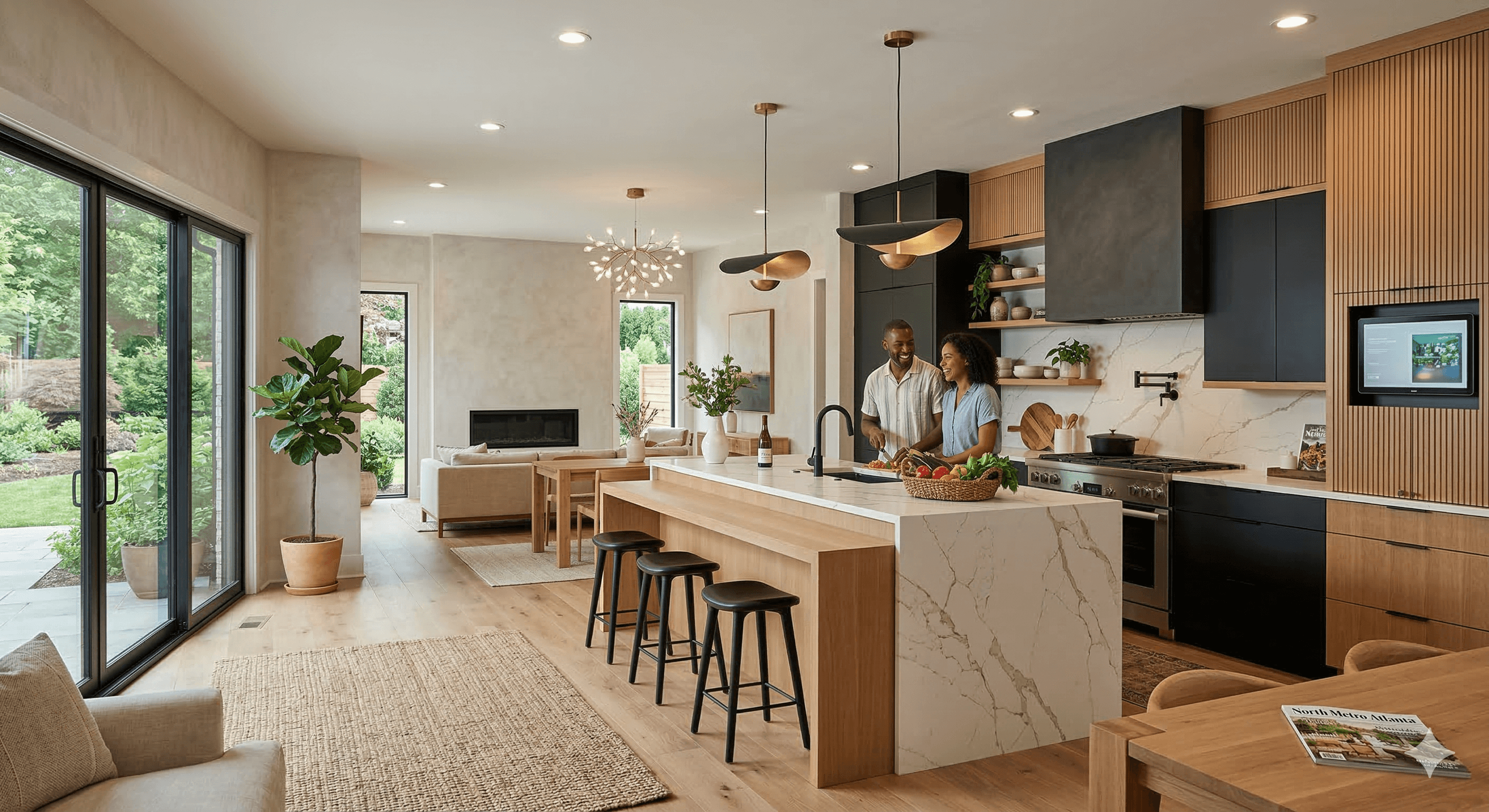
The Modern Kitchen Is No Longer Just a Work Zone
In 2026, the kitchen continues to move far beyond its traditional role as a room for meal prep. It has become the operational center of the home, supporting cooking, entertaining, remote work, after-school routines, and day-to-day family connection. That shift is changing how homeowners approach renovation. The strongest kitchen projects are no longer driven by trend alone. They are built around performance, maintenance, longevity, and a more intentional relationship between design and daily life.
Across Georgia, we are seeing clients prioritize finishes and layouts that feel elevated without becoming fragile. They want kitchens that photograph beautifully, but they also want traffic flow that works during a busy weekday, storage that reduces visual clutter, and lighting that performs as well at 6:30 a.m. as it does during an evening dinner gathering. That balance is what defines the most successful kitchen renovations heading into 2026.
Material Choices Are Becoming More Selective
Homeowners are still drawn to refined surfaces, but there is growing scrutiny around where those materials come from, how they wear over time, and whether they justify their cost. The conversation has become more sophisticated. Instead of simply choosing whatever is currently popular, clients are comparing maintenance requirements, repairability, environmental impact, and long-term visual consistency.
Engineered stone remains widely used, but many projects are now pairing it with natural wood accents, porcelain slab backsplashes, recycled-content surfaces, and warm-toned finishes that soften the overall composition. The result is a kitchen that feels layered rather than overly sterile.
- Porcelain slabs are gaining traction for backsplashes and waterfall edges because they offer a crisp architectural look with excellent stain resistance.
- Rift-cut and quarter-sawn woods remain popular where homeowners want visual warmth without excessive grain movement.
- Low-VOC finishes and adhesives are increasingly requested by families who care about indoor air quality as much as appearance.
Smart Technology Is Finally Becoming Invisible
Earlier generations of smart kitchens often felt experimental. Devices were added for novelty, and the technology could easily outpace the design. In 2026, the better approach is integration. The most professional kitchen remodels use technology quietly, in ways that reduce friction without making the space feel like a showroom for gadgets.
That usually means combining appliance planning, electrical design, and cabinet coordination early in the project. Charging drawers, appliance garages, under-cabinet task lighting, motion-sensor pantry illumination, and strategically placed outlets all matter more than a single headline feature. Smart functionality is most valuable when it supports routine behavior instead of interrupting it.
A high-performing kitchen does not feel technical first. It feels effortless first, and the technology simply helps maintain that experience.
Lighting Design Is Becoming a Core Planning Decision
One of the clearest differences between an average kitchen remodel and a genuinely polished one is lighting. A single layer of recessed cans is rarely enough. The most successful kitchens are now designed with ambient, task, and accent lighting working together from the start.
Under-cabinet lighting improves prep visibility, pendants create rhythm over islands, toe-kick lighting can add subtle nighttime guidance, and dimmable controls allow the room to transition between work mode and social mode. When lighting is treated as a design system rather than an afterthought, every other material in the room performs better visually.
Storage Is Being Evaluated by Function, Not by Volume Alone
More cabinets do not automatically produce a better kitchen. What matters is whether the storage plan matches the way the household actually uses the room. Deep drawers for cookware, vertical tray storage near ovens, integrated waste and recycling pull-outs, concealed small-appliance zones, and pantry shelving sized for real products all outperform generic cabinet counts.
We are also seeing more homeowners reject upper-cabinet-heavy layouts in favor of a lighter composition with carefully designed tall storage elsewhere. This can make the room feel more open, but it only works when the remaining storage has been planned with discipline.
- Map the daily workflow before selecting cabinet accessories.
- Identify where clutter typically accumulates.
- Assign fixed zones for preparation, cleanup, serving, and overflow storage.
Open Layouts Still Matter, but Boundaries Matter Too
Many kitchens are now part of a larger open-plan living environment, yet homeowners are becoming more aware of the tradeoffs that come with that openness. Visual connection remains important, but so do acoustics, appliance noise, and the ability to maintain a sense of order when the room is actively in use.
Because of that, islands, ceiling treatments, flooring transitions, and lighting placement are increasingly being used to define the kitchen without fully enclosing it. This hybrid approach gives homeowners the social benefits of openness while preserving enough structure to make the room feel composed.
What Homeowners Should Prioritize Before Renovating
The strongest kitchen projects usually begin with a clear ranking of priorities. Not every renovation budget can support every upgrade, so it is important to distinguish between cosmetic wants and foundational improvements that will affect how the room performs for the next decade.
- Invest first in layout, electrical planning, and lighting.
- Choose surfaces based on durability and maintenance, not just showroom appeal.
- Coordinate appliances before finalizing cabinetry dimensions.
- Reserve visual statement moments for a few high-impact areas instead of over-designing every surface.
A Better Kitchen Should Feel Calm, Capable, and Lasting
The kitchen trends that will define 2026 are not just about what is new. They reflect a maturing standard in residential renovation: homeowners want rooms that are elegant, practical, and resilient at the same time. Sustainable choices matter, but they must be durable. Smart features matter, but they must be intuitive. Beautiful materials matter, but they must be supported by a layout that genuinely works.
When those priorities are aligned early, the final result is not merely trendy. It is a kitchen that remains relevant, high-performing, and deeply livable long after the renovation is complete.
