Layout Decisions Shape How a Home Feels Every Day
Few renovation choices have a broader impact than layout. Whether walls stay, shift, or disappear affects how a home sounds, how it flows, how light travels, and how comfortably different activities can happen at the same time. That is why the debate between open-concept and traditional layouts remains so important. It is not merely a style preference. It is a decision about how a household wants to live.
For years, open-concept planning dominated residential design conversations. It promised brightness, flexibility, and a stronger social connection between kitchen, dining, and living areas. Those benefits are real. At the same time, many homeowners are now rediscovering the advantages of rooms with clearer boundaries, especially as homes are asked to support work, study, entertainment, and privacy all at once.
The Case for Open Concept
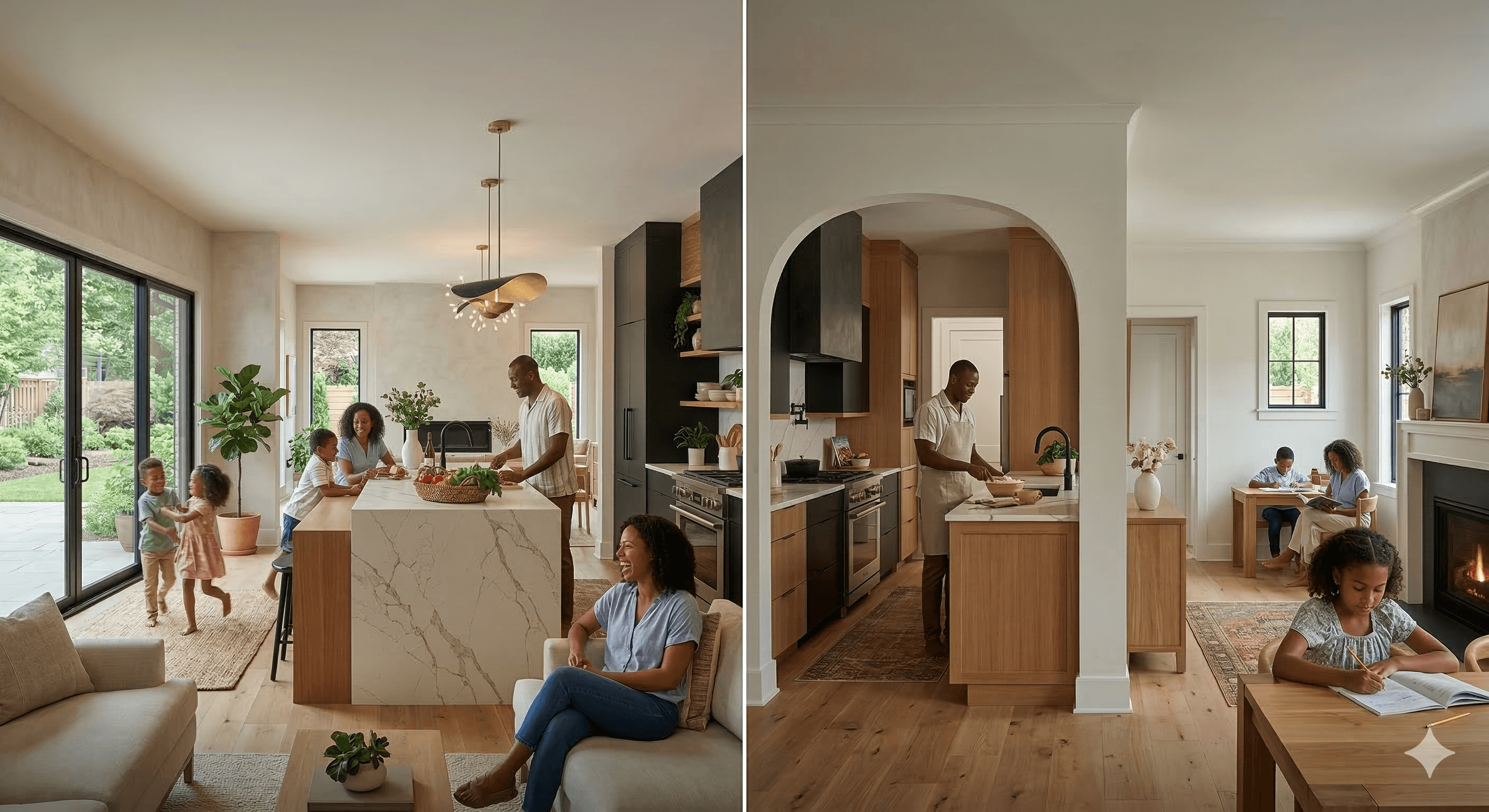
An open layout can make a home feel larger, lighter, and more connected. It improves sightlines, often increases natural light penetration, and supports interaction between family members and guests. For households that entertain frequently or want the kitchen to remain visually connected to adjacent living spaces, openness can be a major asset.
Open plans are also especially effective when the existing footprint is modest. Removing unnecessary partitions can help smaller homes feel less constrained and can improve circulation in spaces that once felt segmented and inefficient.
- Natural light can reach deeper into the floor plan.
- Hosts can cook, serve, and socialize without separation.
- Furniture placement becomes more flexible in multi-use spaces.
- Families with young children often appreciate stronger visual connection.
Where Open Plans Become Challenging
The same openness that creates visual freedom can also create practical friction. Noise travels more easily. Kitchen clutter is always visible. Mechanical sounds from appliances or televisions can compete with conversation. When multiple people are trying to use the home differently at the same time, the lack of separation can become exhausting.
This is one reason many homeowners who once wanted complete openness are now asking for a more measured version of it. They still want flow, but they no longer want every activity happening in one uninterrupted volume.
The Value of Traditional Layouts
Traditional room divisions offer something that has become increasingly valuable: control. Defined rooms allow for privacy, acoustic separation, more intentional furniture arrangements, and the ability to close off visual mess when needed. They also support households in which different people need the home to perform different roles at the same time.
A formal dining room can become a quiet office. A closed den can support focused work or media use. A separated kitchen can contain noise and cleanup during entertaining. In other words, traditional layouts can offer more operational flexibility than they are often given credit for.
Privacy is not the opposite of good design. In many homes, privacy is one of the features that makes good design feel sustainable over time.
How to Decide What Is Right for Your Home
The best layout is not determined by trend forecasts alone. It depends on how the household uses the space from morning to night. A family that entertains often and values visual openness may benefit from fewer barriers. A household with remote work needs, varying schedules, or a preference for quieter zones may be better served by stronger separation.
Before removing walls, it is worth evaluating several practical questions:
- Does the household need more privacy or more connection?
- Will sound control matter during work, study, or entertainment?
- Is the current floor plan dark and compartmentalized, or simply structured?
- Will the renovation improve furniture layout and circulation, or just create emptier space?
Hybrid Solutions Often Deliver the Best Outcome
In many cases, the strongest answer is neither fully open nor strictly traditional. Hybrid layouts can preserve sightlines while introducing architectural definition where it matters. Wider cased openings, partial walls, framed portals, glass partitions, ceiling changes, and strategically placed millwork can create separation without making the home feel closed off.
This approach allows homeowners to keep visual continuity while improving acoustics, furniture zoning, and overall composure. It is especially effective in homes where a full structural opening would be expensive or where complete openness would reduce functionality.
Structural Reality Still Matters
One of the most common renovation mistakes is treating every wall as if it exists only for aesthetics. Some walls carry loads, conceal mechanical systems, or help define practical circulation paths. Removing them may be possible, but doing so can require beams, posts, rerouted utilities, and meaningful cost escalation.
That does not mean change should be avoided. It means layout renovation should be approached with both design ambition and construction discipline. The goal is not simply to remove boundaries. The goal is to improve the way the house works.
Designing for the Next Ten Years
Homeowners often focus on what feels right today, but layout decisions should also anticipate how needs may evolve. Children grow, work habits change, entertaining styles shift, and households increasingly expect one home to support multiple modes of living. A well-considered plan should be able to adapt without requiring another major renovation too soon.
That is why the best layout discussions start with lifestyle, continue through structure and budget, and end with long-term flexibility. Whether the result is open, traditional, or somewhere in between, success comes from alignment between the plan and the people living inside it.
The Right Answer Is the One That Improves Daily Use
There is no universal winner in the open-concept versus traditional debate. Each approach offers real strengths, and each can create limitations when applied without enough context. What matters most is how well the final layout supports light, movement, privacy, comfort, and the routines that define the home.
When that decision is made carefully, the result feels less like a trend choice and more like a durable upgrade in how the home functions every day.
