
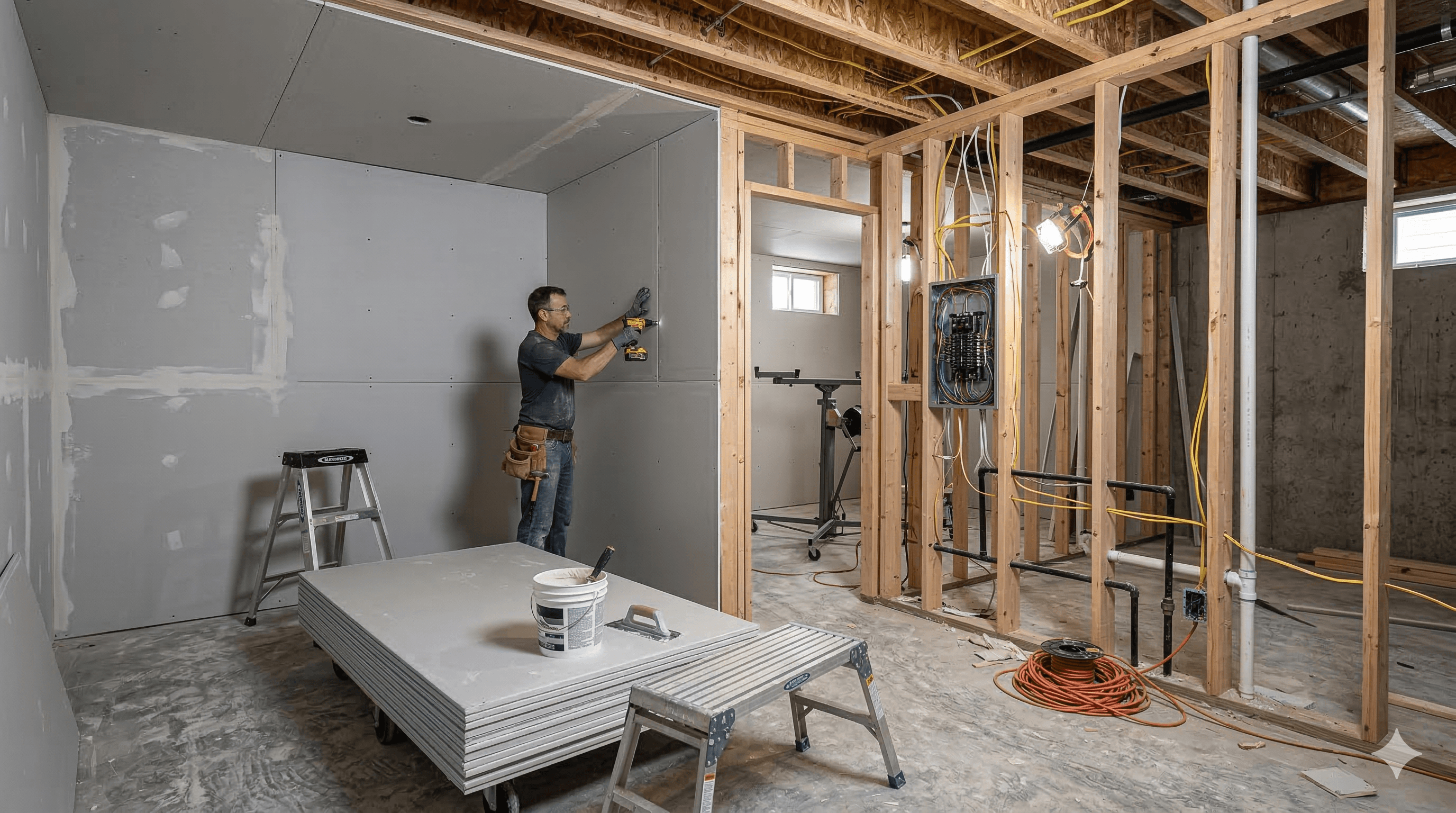
Basement Finishing Is About More Than Resale Math
When homeowners think about return on investment, the conversation usually starts with resale value. That is understandable, but it is also incomplete. A finished basement can improve market appeal and add usable square footage, yet its strongest value often comes from how dramatically it improves daily life before a home is ever listed for sale.
In Georgia, basement finishing continues to stand out because it uses space that already exists within the home’s footprint. That means homeowners can often achieve a meaningful increase in functionality without taking on the same site constraints, structural complexity, and zoning implications that come with a full addition. When planned properly, a basement can become one of the most versatile and financially sensible areas of the house.
Why the ROI Conversation Needs Context
National cost-versus-value reports are useful reference points, but they should never be treated as universal guarantees. The true return on a basement project depends on location, neighborhood standards, construction quality, and whether the finished space feels integrated with the rest of the home. A poorly lit basement with generic finishes may add square footage on paper, but it will not create the same value as a well-detailed lower level that feels intentional and welcoming.
There is also a practical distinction between appraisal value and lifestyle value. A basement that functions as a media room, guest suite, fitness space, office, or multi-purpose family zone can relieve pressure on the main floor immediately. For many homeowners, that benefit alone justifies the investment long before resale enters the equation.
The Best Basement Projects Start With Moisture and Envelope Planning
No amount of cabinetry, flooring, or finish work can compensate for unresolved moisture issues. Before a basement is framed or designed, the space should be evaluated for water intrusion, humidity imbalance, insulation gaps, and any signs that the envelope is underperforming. This is the step that protects the investment.
A professional basement remodel should account for waterproofing strategy, drainage conditions, air movement, and material selection suitable for below-grade conditions. Skipping this work creates risk not only for finishes, but also for indoor air quality and long-term maintenance.
- Inspect for seepage, staining, and previous patch repairs.
- Review dehumidification and ventilation requirements.
- Choose flooring and trim assemblies appropriate for basement conditions.
- Verify that electrical, HVAC, and plumbing upgrades are coordinated before closing walls.
Function Drives Value
One of the biggest reasons basement finishing delivers strong returns is flexibility. A basement can solve multiple household needs at once when it is zoned correctly. Instead of treating it as one oversized room, the better approach is to define distinct functions and circulation paths from the beginning.
For example, a lower level might include a lounge area, a dedicated office, a compact wet bar, a guest bedroom, and a full bath. In another home, the same square footage might work better as a children's retreat, a game room, and a quiet study area. The project becomes more valuable when the plan responds to real lifestyle patterns instead of generic expectations.
The most successful basement is not the one with the most features. It is the one that solves the most useful problems for the household that lives there.
Design Quality Determines Whether the Space Feels Like an Asset
Many unfinished basements suffer from the same challenges: limited natural light, exposed structure, awkward mechanical runs, and a psychological sense of separation from the rest of the home. Good design can address each of these issues. Ceiling planning, lighting placement, warm finishes, controlled color contrast, and disciplined trim details all help turn a lower level into a true extension of the residence rather than an afterthought.
Thoughtful basement renovations often rely on layered lighting, better stair transitions, and clean sightlines from one activity zone to another. When those elements are handled well, the space feels deliberate and comfortable instead of secondary.
Common High-Value Basement Uses
Not every basement should be finished the same way. The right program depends on the home, the family, and the expected length of ownership. Still, certain uses tend to deliver reliable value because they increase flexibility and support changing household needs over time.
- Guest accommodations: Ideal for extended family visits or multi-generational living.
- Home office zones: Especially important for households that need privacy and acoustic separation.
- Media and recreation rooms: Useful for entertaining without overwhelming the main living areas.
- Fitness or wellness spaces: Increasingly popular as homeowners want more at-home convenience.
Where Homeowners Make Mistakes
Several issues tend to reduce the long-term return of a basement project. The first is underinvesting in infrastructure while overspending on decorative finishes. The second is ignoring code and egress requirements that affect safety, insurance, and future resale. The third is creating a layout that is so narrowly tailored that it becomes difficult for future buyers to repurpose.
A better approach is to prioritize code-compliant planning, durable materials, flexible layouts, and strong environmental control. Those decisions may be less visible in listing photos, but they are exactly what preserve value over time.
The Real Return Is Capacity
Ultimately, the appeal of basement finishing lies in what it gives a home: more capacity. More room to host, more room to work, more room for privacy, and more room for changing family needs. In a market where expanding outward is often expensive and complicated, improving the lower level remains one of the most practical ways to unlock hidden value.
For Georgia homeowners, that makes basement finishing more than a cosmetic upgrade. It is a strategic renovation that can improve how a house performs now while strengthening its long-term usefulness and market position.
